- Proposed
- Under Assessment
- Preliminary Assessed
- Assessed
- CRPublished
Deconica baylisiana (E. Horak) J.A. Cooper
Search for another species...
- Scientific name
- Deconica baylisiana
- Author
- (E. Horak) J.A. Cooper
- Common names
- IUCN Specialist Group
 Mushroom, Bracket and Puffball
- Kingdom
- Fungi
- Phylum
- Basidiomycota
- Class
- Agaricomycetes
- Order
- Agaricales
- Family
- Strophariaceae
- Assessment status
- Published
- Assessment date
- 2019-07-23
- IUCN Red List Category
- CR
- IUCN Red List Criteria
- D
- Assessors
- Jerry Cooper (Landcare Research, Lincoln, New Zealand)
- Reviewers
- Gregory Mueller (Chicago Botanic Garden / IUCN SSC Mushroom, Bracket and Puffball Specialist Group)
Assessment Notes
The content on this page is fetched from The IUCN Red List of Threatened Species: https://www.iucnredlist.org/species/154239294/154239311
Justification
This species has a restricted population with an estimated 36-90 mature individuals. Taking a precautionary approach, it therefore qualifies as Critically Endangered under criterion D.Taxonomic notes
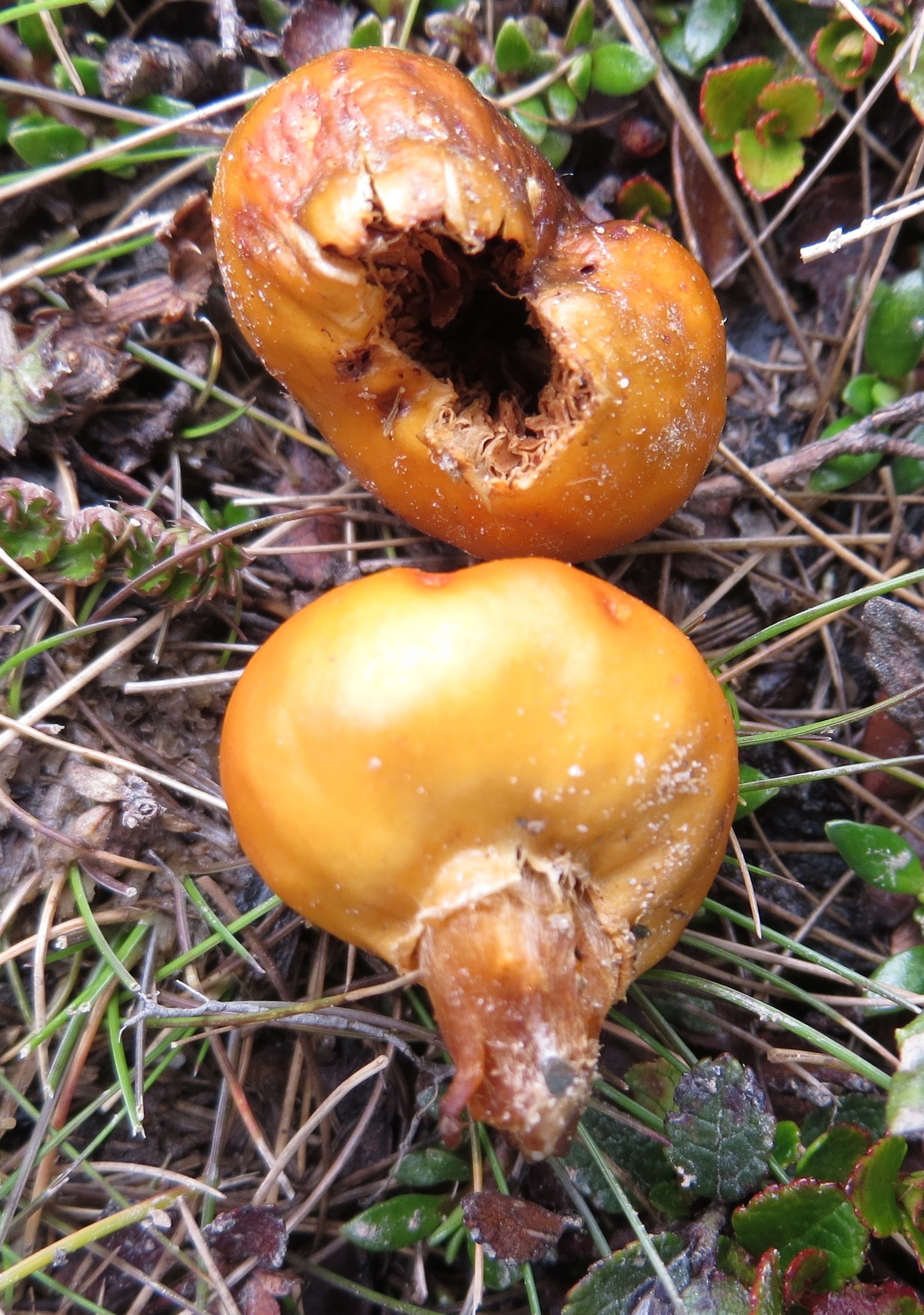
Deconica baylissiana is a saprophytic secotioid (pouch) fungus endemic in southern New Zealand. It is the only such New Zealand species associated with upland/alpine grassland and is easily seen and recognised due to its bright colour in open habitat. The species is sequence barcoded and phylogenetically well characterised. Truffle-like species have been extensively surveyed in New Zealand for over 50 years.Geographic range
This species has only been recorded from alpine southern South Island, and Stewart Island, New Zealand.Population and Trends
The species is known from three records, of only a few sporocarps, in three sites over an 83 year period. We infer the presence of 3 genotypes, x 3 to account for unrecorded individuals at the known sites, x 2-5 to convert to mature individuals, giving 18-45 mature individuals present in the known sites. Considering this is a conspicuous fungus found in very specific habitats, a multiplier of 2 is considered appropriate to account for unknown sites, giving a total estimate of 36-90 mature individuals. Climate change will impact on populations.
Population Trend: Decreasing
Habitat and Ecology
This is a conspicuous species associated with alpine/upland grasslands in southern New Zealand. Secotioid species do not have active spore dispersal and rely on animal vectors. The identity of the vector is unknown.Threats
Forest truffle-like species are presumed to be dispersed by flightless birds like the extinct Moa and the threatened Kiwi and Kakapo. The identity of the vector for this upland species is unknown but is likely to be extinct or threatened. In addition, as an alpine species, it is likely to be negatively impacted by climate change. There are invasive feral animals present in the areas of its distribution, but it is unknown whether this is a threat to the species.Conservation Actions
Both known sites of this species are within Protected Areas.Research is needed on the identity of the spore dispersal vector and the impact of climate change.