- 1Proposed
- 2Under Assessment
- 3Preliminary Assessed
- 4Assessed
- 5Published
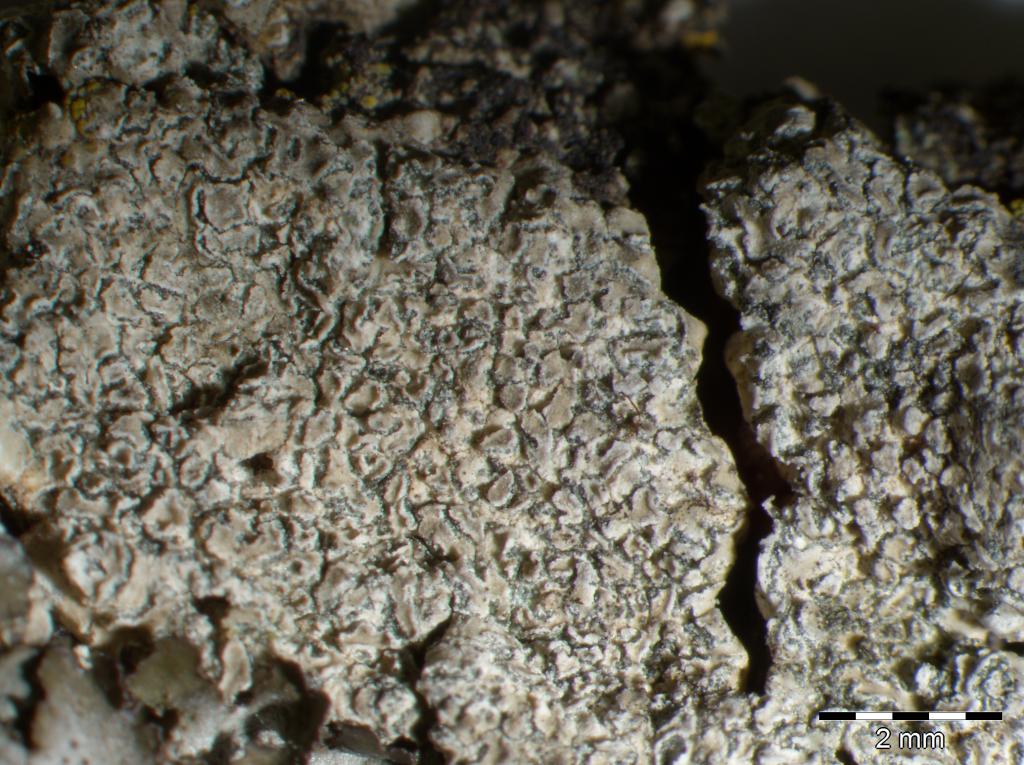
Megaspora rimisorediata Valadbeigi
- Scientific name
- Megaspora rimisorediata
- Author
- Valadbeigi
- Common names
- IUCN Specialist Group
 Lichens
- Kingdom
- Fungi
- Phylum
- Ascomycota
- Class
- Lecanoromycetes
- Order
- Pertusariales
- Family
- Megasporaceae
- Assessment status
- Dormant
- Proposed by
- Arsen Gasparyan
- Contributors
- Arsen Gasparyan, Alexander Paukov
- Comments etc.
- Anders Dahlberg
Assessment Notes
Taxonomic notes
Why suggested for a Global Red List Assessment?
Megaspora rimisorediata is species with small geographic range (Southern Armenia and Northern part of Iran). The species seems to be threatened by climate change, mining and logging. According to Valadbeigi et al. (2011), the climate and environmental conditions are important for extension of the thallus and producing soralia.
Geographic range
The species was found only from Northern part of Iran (Valadbeigi et al., 2011) and Southern Armenia (Gasparyan & Sipman, 2013).
Population and Trends
Population Trend: Uncertain
Habitat and Ecology
The species mainly distributed in open arid woodland ecosystems (mountainous xerophytic vegetation). It is generally corticolous and rarely muscicolous and saxicolous (calciferous rocks). It was found on bark of Juniperus sp., Quercus brantii and Q. castaneifolia in Iran (Valadbeigi et al., 2011) and on bark of Quercus sp. in Armenia (Gasparyan & Sipman, 2013).
Threats
The main threats for the species are changes of climate and environmental conditions, habitat loss and land transformation by mining, as well as logging.
Conservation Actions
The few localities are known for Golestan National Park and Arasbaran protected area in Iran. No any conservation action or site protection in Armenia.
Research needed
The species was described in 2011 by Valadbeigi et al. The additional research on population size, distribution and ecology is required. The data should be considered during conservation planing and development of Nature Specially Protected Areas network.
Use and Trade
Bibliography
Gasparyan A. & Sipman H. J. M. 2013: New lichen records from Armenia. - Mycotaxon 123: 491-492.
Valadbeigi T., Nordin A. & Tibell L. 2011: Megaspora rimisorediata (Pertusariales, Megasporaceae), a new sorediate species from Iran and its affinities with Aspicilia sensu lato. - The Lichenologist 43: 285-291.