- Proposed
- Under Assessment
- 3Preliminary Assessed
- 4Assessed
- 5Published
Rubroboletus pulchrotinctus (Alessio) Kuan Zhao & Zhu L. Yang
- Scientific name
- Rubroboletus pulchrotinctus
- Author
- (Alessio) Kuan Zhao & Zhu L. Yang
- Common names
 Боровик красивоокрашенный
- IUCN Specialist Group
 Mushroom, Bracket and Puffball
- Kingdom
- Fungi
- Phylum
- Basidiomycota
- Class
- Agaricomycetes
- Order
- Boletales
- Family
- Boletaceae
- Assessment status
- Under Assessment
- Proposed by
- Susana C. Gonçalves
- Assessors
- Claudia Perini, Tatyana Svetasheva, Susana C. Gonçalves, Izabela L. Kalucka, Armin Mešić, Alona Yu. Biketova
- Editors
- Gregory Mueller
- Contributors
- Georgios Zervakis
- Comments etc.
- Anders Dahlberg
Assessment Notes
Taxonomic notes
The appropriate name of this species is Rubroboletus pulchrotinctus (Alessio) Kuan Zhao & Zhu L. Yang, based on molecular phylogeny it belongs to the genus Rubroboletus Kuan Zhao & Zhu L. Yang (Zhao et al. 2014, Tibpromma et al. 2017).
Why suggested for a Global Red List Assessment?
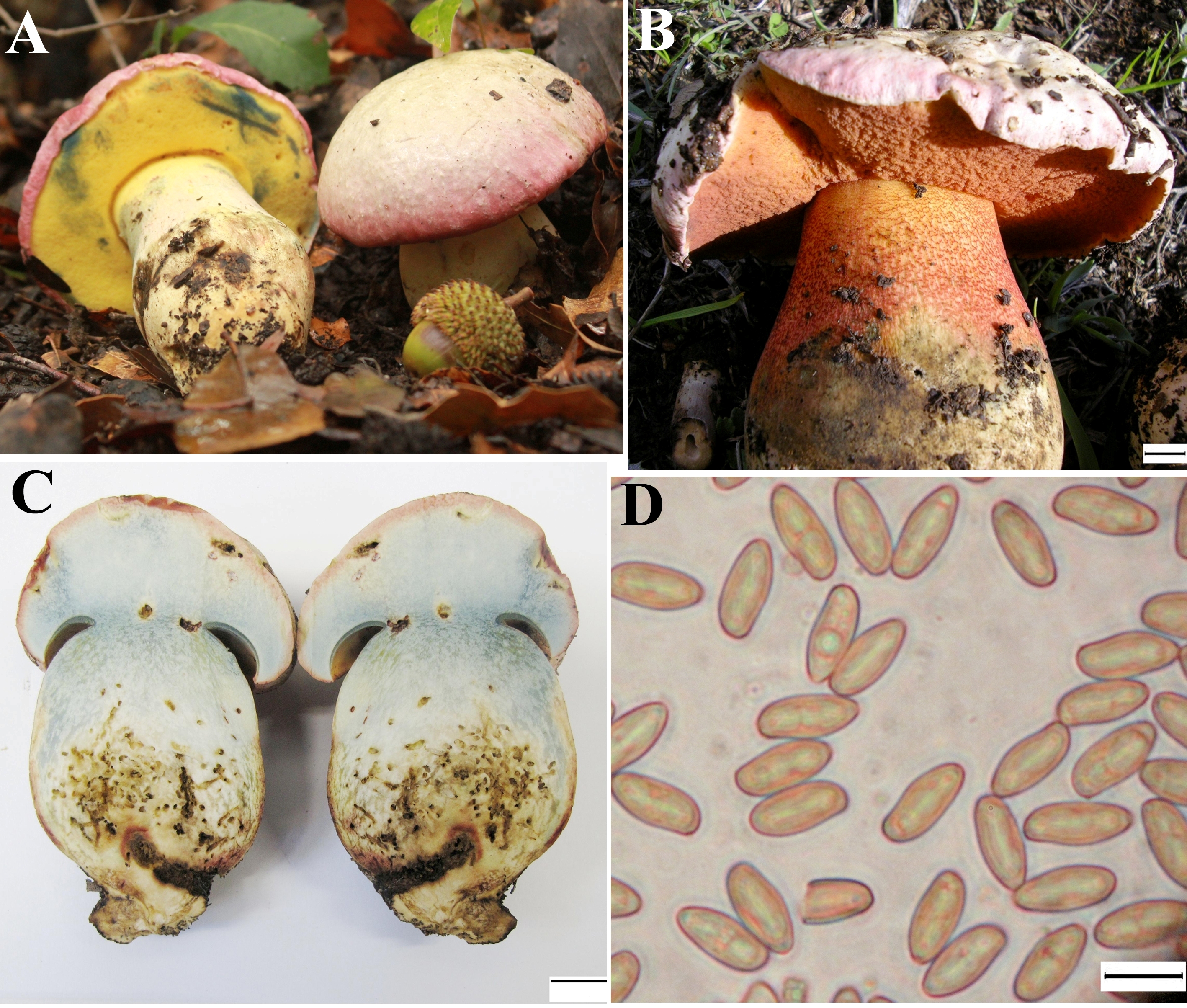
Rubroboletus pulchrotinctus is a rare bolete native to central and southern Europe and the Middle East.
Geographic range
The species is known from Europe across the Mediterranean including Balearic Islands, Balkan region, and Crimean Peninsula and the Middle East including Israel and Cyprus (Lambert 1987; Jurc et al. 2004; Muñoz 2005; Karadelev et al. 2006; Calzada Domínguez 2007; Sarkina 2008; Konstantinidis 2009; Lukić 2009; Kasom & Karadelev 2011; Biketova et al. 2016; Loizides 2019).
Population and Trends
For the all-time of observation about X localities were registered: Italy - X localities, Israel - 20, Spain - 11, France - X, Greece - 10, Russia - 2, Slovenia - 1, Croatia - X, Serbia - 1, Macedonia - 1, Montenegro - 1, Cyprus - 1.
It’s redlisted in Italy and Macedonia (? and EN, correspondingly) and included in Red book of the Republic of Crimea (3 - Rare Species). Its population is stable only in Israel.
Population Trend: Uncertain
Habitat and Ecology
Rubroboletus pulchrotinctus is a mycorrhizal fungus, growing solitary or in groups in thermophilous broad-leaved (primarily evergreen oaks) and mixed forests with a Mediterranean climate, with Quercus ilex, Q. rotundifolia, Q. cerris, Q. calliprinos, Q. alnifolia, Q. infectoria, Q. pubescens, Q. suber, Castanea sativa, Ostrya carpinifolia, Arbutus unedo, Pinus halepensis, Pinus pinea, Pinus pinaster, Juniperus communis, J. oxycedrus ssp. badia, Buxus sempervirens, Erica arborea, Pistacia lentiscus, Cistus salvifolius, and Phillyrea latifolia, on calcareous soils (Alessio 1985; Simonini 1995; Vila et al. 2004; Muñoz 2005; Calzada Domínguez 2007; Galli 2007; Mir & Melis 2008; Biketova et al. 2016; Loizides at al. 2019).
Threats
The main threats for this species and it’s habitats are clear-cutting of noted types of forest, replacement of oak forest by pine plantations, residential & commercial development of natural habitats, limestone minings, livestock farming & ranching, and fires.
Conservation Actions
Research needed
There are photos of this species taken by amateurs from Lebanon. Its distribution in Lebanon needs to be proven by a scientific publication.
Use and Trade
It may be consumed by some local people, but its edibility is doubtful (Maletti 2009). Poisoning cases (gastrointestinal syndrome) were reported in Italy (Sitta et al. 2020) and Israel.