- Proposed
- Under Assessment
- CRPreliminary Assessed
- 4Assessed
- 5Published
Dirina indica Upreti & Nayaka
- Scientific name
- Dirina indica
- Author
- Upreti & Nayaka
- Common names
- IUCN Specialist Group
 Lichens
- Kingdom
- Fungi
- Phylum
- Ascomycota
- Class
- Arthoniomycetes
- Order
- Arthoniales
- Family
- Roccellaceae
- Assessment status
- Preliminary Assessed
- Preliminary Category
- CR C2a(ii)
- Proposed by
- SILJO JOSEPH
- Assessors
- SILJO JOSEPH
- Comments etc.
- Jessica Allen
Assessment Notes
Taxonomic notes
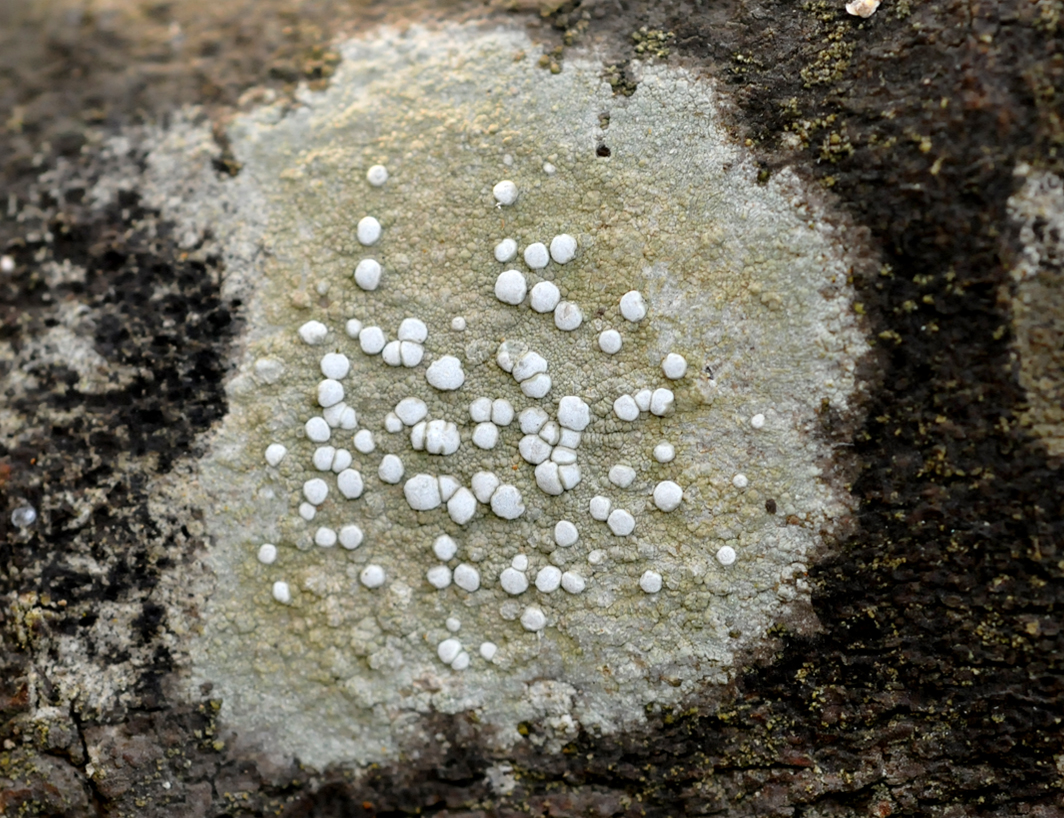
It is a crustose lichen species within the family Roccellaceae. Formally introduced as a new species in 2013 by Upreti and Nayaka in Tehler et al. (2013), the type specimen of Dirina indica was collected from Pirotan Island, located within the Marine National Park of Gujarat coast. The species can be distinguished by obligately corticolous thallus, sessile ascomata, base
not constricted or semi-constricted, white pruinose disc with
even surface, C+ red, and 3-septate ascospores of 22–27 × 4–5 µm.
Why suggested for a Global Red List Assessment?
There are two identified subpopulations: one on the western coast of India in Gujarat, and the other on the southern coast of the Arabian Peninsula, including Socotra Island in Yemen.
EOO: 857,561 sq km
AOO: 60 sq km
Localities: 2
Number of individuals known: 53 [India: 51; Yemen: 2]
The EOO seems to be large, however, the populations in India and Yemen are geographically isolated by the ocean. The species in question because primarily grow on mangrove plants, mainly threatened by a range of natural calamities and anthropogenic stressors.
Geographic range
The species was described in 2013 based on the type specimen from India (with three additional specimens), and two additional collections from Yemen (Abian Governorate and Socotra Island). As part of the ongoing revisionary studies focusing on Arthoniales in India, a total of 53 individuals were collected from the west coast of Gujarat. However, it is worth noting that the species could not be located in other coastal regions of India.”
Population and Trends
Approximately 51 individuals of this species were collected along the western coasts of Gujarat, India. They primarily inhabit the bark of mangrove plants, with a significant presence in areas falling under the purview of the Marine National Park and its adjacent islands. Interestingly, this species remained uncollected in other coastal regions of India, despite some surveys. So far, two collections are known from Yemen (one each from the Arabian Peninsula and Socotra Island). The population size is suspected to be decreasing due to impacts to and loss of habitat, specifically mangrove forests.
Population Trend: Decreasing
Habitat and Ecology
It is strictly corticolous and found growing on various mangrove trees and shrubs such as Avicennia, Adenium, Acacia, Prosopis, Salvadora and Ceriops.
Threats
This species faces a significant threat from various sources, including tourism, extensive fishing operations, and shipyard activities. Notably, the local population is engaged in substantial harvesting of Prosopis juliflora and other mangrove trees for firewood, adding to the pressure on the species. The vulnerability of the Indian west coast to tsunamis and cyclones further compounds the challenges it confronts. It is interesting that the habitat of the species sharing the international boundaries, and the conservation of border species can be challenging due to jurisdictional complexities. The effects of these issues cannot be negated.
Conservation Actions
Required conservation actions include protection of sites where the species is known to occur and protection of mangrove forest, along with awareness and education programs. Further, the species distribution spans multiple countries and international-level collaboration and research is required to fully understand the status of this species.
Research needed
Long term monitoring of population trends is required to better understand the change in the total number of individuals over time and to better measure and detect declines.
Use and Trade
Bibliography
1. Tehler, A., Ertz, D., and Irestedt, M. 2013. The genus Dirina (Roccellaceae, Arthoniales) revisited. The Lichenologist 45(4): 427-476.
2. Ingle, K.K. 2018. Morphotaxonomic and ecological studies on mangrove lichens of Gujarat state, India. Ph.D. thesis submitted to Barkatullah University, Bhopal, Madhya Pradesh.
3. S. Joseph. 2015. Revisionary studies on the family Roccellaceae sensu lato in India. Flora of India Project, Final Report submitted to the Botanical Survey of India, Kolkata.