- Proposed
- Under Assessment
- Preliminary Assessed
- Assessed
- LCPublished
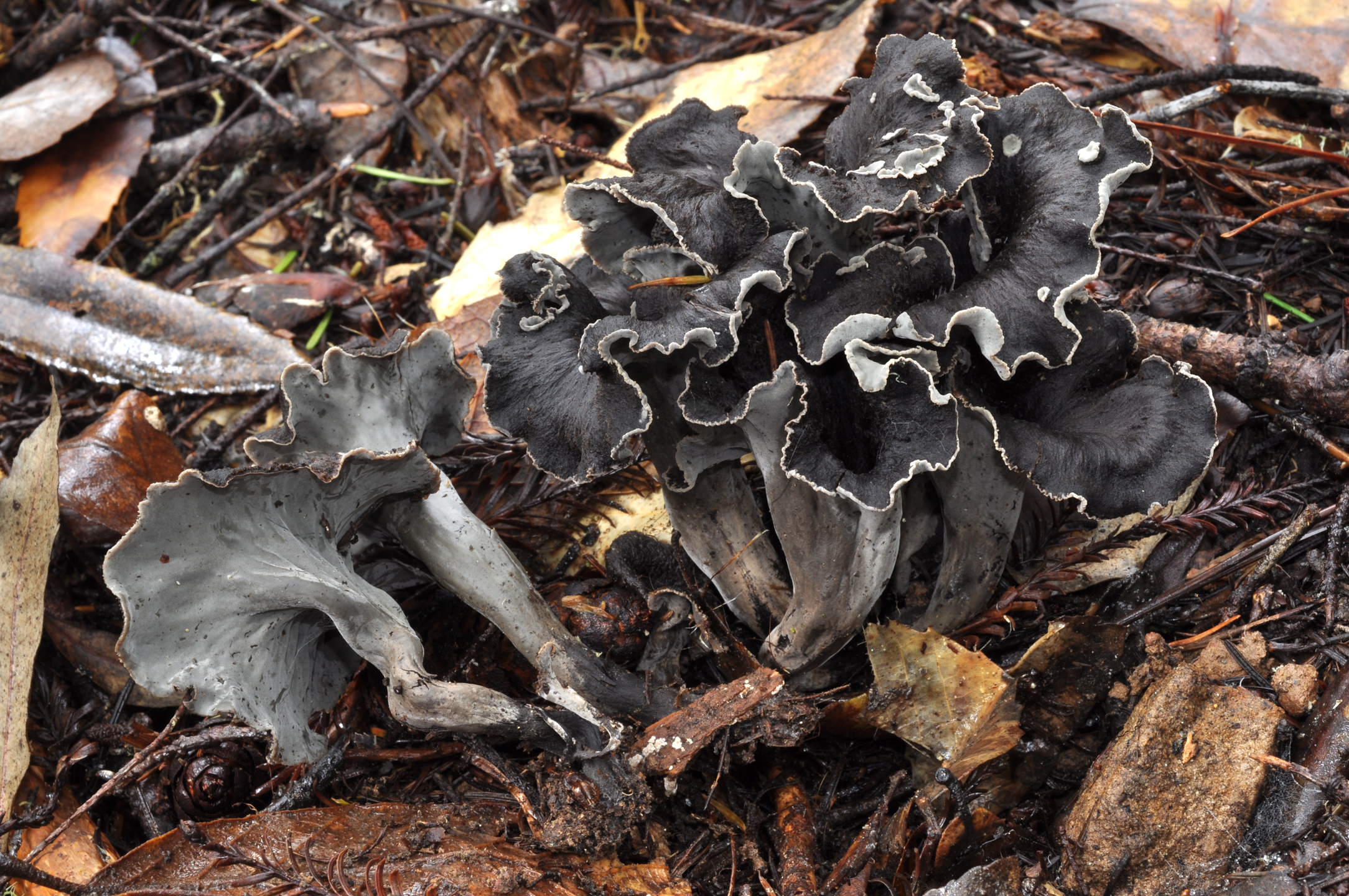
Craterellus calicornucopioides D. Arora & J.L. Frank
Search for another species...
- Scientific name
- Craterellus calicornucopioides
- Author
- D. Arora & J.L. Frank
- Common names
- IUCN Specialist Group
 Mushroom, Bracket and Puffball
- Kingdom
- Fungi
- Phylum
- Basidiomycota
- Class
- Agaricomycetes
- Order
- Cantharellales
- Family
- Hydnaceae
- Assessment status
- Published
- Assessment date
- 2021-03-01
- IUCN Red List Category
- LC
- Assessors
- Noah Siegel (25 Prospect Hill Road, Royalston, MA 01368, US / Global Fungus Assessment)
- Reviewers
- Anders Dahlberg (Swedish Species Information Centre, Uppsala / IUCN SSC Cup-fungus, Truffle and Ally Specialist Group)
Assessment Notes
The content on this page is fetched from The IUCN Red List of Threatened Species: https://www.iucnredlist.org/species/189958461/198625182
Justification
Craterellus calicornucopioides is widespread and common. Local declines are expected, mostly from habitat loss due to Sudden Oak Death killing the preferred host tree, Tanaok, but the overall population is thought to be broadly stable. Due to the the total extent of occurrence and limited local declines, it is assessed as Least Concern.Taxonomic notes
Craterellus calicornucopioides was long referred to by the name of the European species, C. cornucopioides (Thiers 1985, Arora 1986). The distinct western North American entity was described from a type collection made in Mendocino County, California, USA (Frank 2015).Geographic range
Craterellus calicornucopioides is known from central California, USA, north into Washington state. This species is most common in Tanoak (Notholithocarpus densiflorus) dominated forests in northern California and south-west Oregon, but occasional in live oak woodlands to the south and found mostly with Oregon White Oak (Quercus garryana) to the north.Population and Trends
The population of this species is widespread, occurring over a large expanse of the western USA. Locally, it is a very abundant species. Most of the population is currently stable, but decline of Tanoak due to the introduced pathogen Sudden Oak Death (Phytophthora ramorum) is a localized threat.
Population Trend: Stable