- 1Proposed
- 2Under Assessment
- 3Preliminary Assessed
- 4Assessed
- 5Published
Parmelina atricha (Nyl.) P. Clerc
- Scientific name
- Parmelina atricha
- Author
- (Nyl.) P. Clerc
- Common names
- IUCN Specialist Group
 Lichens
- Kingdom
- Fungi
- Phylum
- Ascomycota
- Class
- Lecanoromycetes
- Order
- Lecanorales
- Family
- Parmeliaceae
- Assessment status
- Dormant
- Proposed by
- Sergio Perez-Ortega
- Assessors
- Sergio Perez-Ortega
- Comments etc.
- Christoph Scheidegger, Anders Dahlberg
Assessment Notes
Taxonomic notes
Description from (Clerc & Troung 2008):
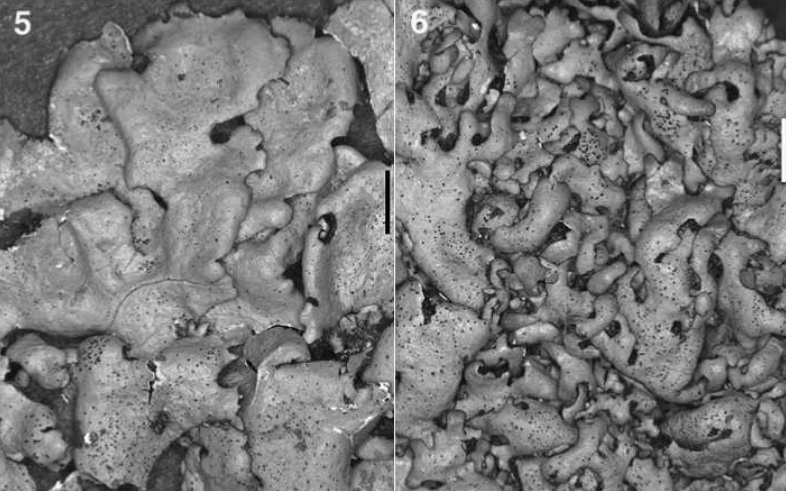
Thallus foliose, up to 10 cm diam, loosely adnate, ± rosette forming, central areas of the thallus covered by numerous overlapping and narrow lobes becoming (panniform). Lobes at the periphery of the thallus up to 3 mm wide, dichotomously or irregularly branched, contiguous to overlapping, flat to slightly concave, lobe tips ± rotund and crenate, not pruinose. Secondary central lobes narrower, up to 2 mm wide, irregularly
or dichotomously branched, numerous and densely overlapping. Upper surface light grey to yellowish grey, smooth, often shiny, without maculae. Medulla white, lower surface black and shiny with up to 2 mm long unbranched rhizines. Ascomata common, c. 2-3 mm diam, disc red brown, margins thick, lower side distinctily wrinkled, with none or few rhizines. Ascospores colourless, 1-celled, short ellipsoid, 8-11 x 5-7 pm. Pycnidia: usually numerous; conidia: 5-7 x 1 pm, bacilliform, straight.According to recent phylogenetic studies (Núñez-Zapata 2013) Parmelina atricha is paraphyletic since P. carporrhizans is nested within the former taxon. This seems to be the case of other Parmelina species (Núñez-Zapata 2013). The species is considered a ‘good species’ (Dr. A. Crespo pers. comm.).
Why suggested for a Global Red List Assessment?
The species was proposed as it may be a rare macrolichen species, but it seems that the species has been overlooked and might be much more abundant as previously thought. According to P. Clerc (pers. comm.) there are no clear threats to the Swiss populations and they are in good shape.
Criterion A: There are no reports about the trends of population size over long time periods, so it is not possible to apply this criterion.
Criterion B: Both B1 and B2 could be applied as the extent of occurrence (EOO) is likely less than 500 km2 according to the current knowledge. However the number of populations is larger than 10 and no decline or extreme fluctuations has been reported.
Criterion C: No information is available about the total number of individuals of this species. Thus, subcriteria C1 and C2 are not applicable.
Criterion D: The total number of individuals is unknown and area of occupancy (AOO) is likely larger than 20 km2. This criterion does not apply.
Criterion E: No quantitative analyses have been carried out.
The species is thus evaluated as Least Corcern.
Geographic range
Population and Trends
There is not information about population sizes and dynamics. The species is known from single localities in Spain and Italy. Recent work in Switzerland found it in at least 7 localities although all collections are older than 35 years old. Recent visits to old localities confirm the occurrence of the species nowadays (Clerc pers. comm). Further new localities have been discoverred in Swizertland.
The species seems to be relatively common in Eastern Pyrenees as recently stated by Roux et col. (2104) in the Checklist of French lichens.
Population Trend: Uncertain
Habitat and Ecology
This species requires large siliceous boulders in open forest in a quite humid situation. It occurs between (500) 1100 and 1500 (1740) m.
Threats
Conservation Actions
Research needed
Use and Trade
Bibliography
P. Clerc and C. Truong 2008: The non-sorediate and non-isidiate Parmelina species (lichenized ascomycetes, Parmeliaceae) in Switzerland — Parmelina atricha (Nyl.) P. Clerc reinstated in the European lichen flora. - Sauteria 15: 175-194.
J. Núñez-Zapata 2013. Variabilidad genética, especies crípticas y filogenia molecular en hongos liquenizados del género Parmelina (PArmeliaceae, Ascomycota. PhD dissertation. Universidad Complutense de Madrid.
C. Roux et col. 2014. Catalogue des lichens et champignons lichénicoles de France. 1500 pp.