- Proposed
- Under Assessment
- Preliminary Assessed
- DDAssessed
- 5Published
Hygrocybe monteverdae Bañares & Arnolds
- Scientific name
- Hygrocybe monteverdae
- Author
- Bañares & Arnolds
- Common names
- IUCN Specialist Group
 Mushroom, Bracket and Puffball
- Kingdom
- Fungi
- Phylum
- Basidiomycota
- Class
- Agaricomycetes
- Order
- Agaricales
- Family
- Hygrophoraceae
- Assessment status
- Assessed
- Preliminary Category
- DD
- Proposed by
- Eef Arnolds
- Assessors
- Eef Arnolds
- Editors
- Anders Dahlberg
- Comments etc.
- John Bjarne Jordal (old account)
Assessment Notes
R-L categories correct, but text here does not match final assessment. Updated version will be published in IUCN´s Red List
Justification
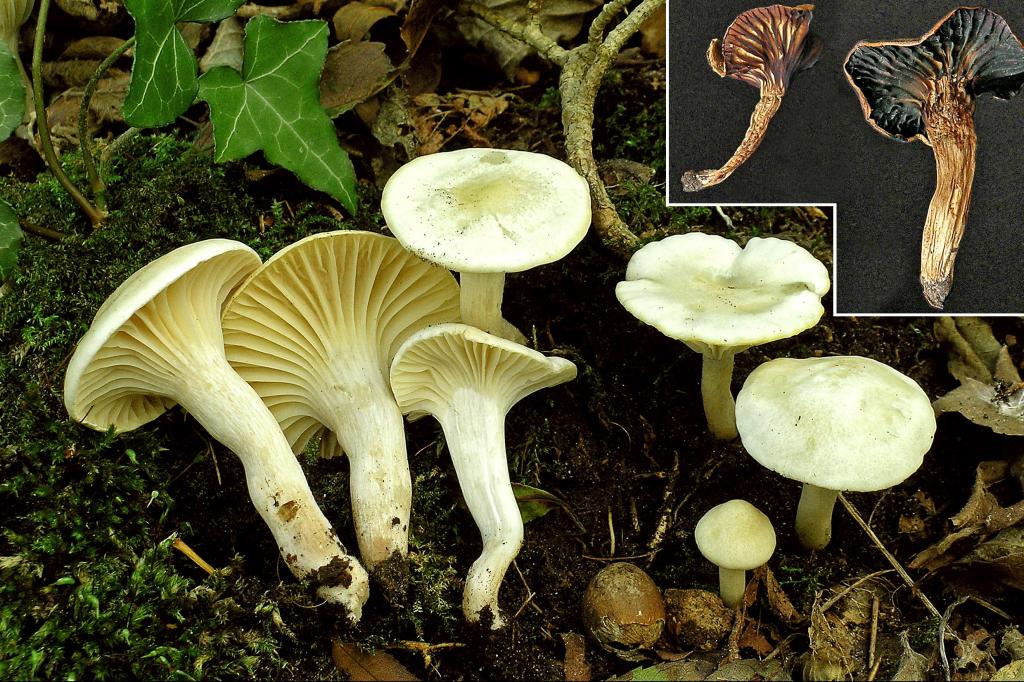
Hygrocybe monteverdae is somewhat similar to Cuphophyllus pratensis var. pallida (= C. berkeleyi), but well-characterized by a more slender habit, black discoloration on drying and larger spores. The species is restricted to Northwestern Europe and the Canary Islands, very rare and confined to special and threatened habitats: old, undisturbed deciduous forests and old, unimproved grasslands on base-rich, calcareous soils. In view of the very small population H. monteverdae is proposed for the global Red List as Endangered (D1).
Taxonomic notes
Hygrocybe monteverdae in fact belongs to the genus Cuphophyllus but the combination in that genus was not yet proposed.
Why suggested for a Global Red List Assessment?
Geographic range
At present Hygrocybe monteverdae is known from six localities: two in Canary Islands (La Palma), one site in the Netherlands, two in Sweden (Öland and Gotland), one in Norway and one in Estonia (Sarumaa).
Population and Trends
The extent of occurrence of Hygrocybe monteverdae is over 40,000 km2; the estimated area of occupancy less than 100 km2. The known populations consist each of less than 10 mycelia. Possibly some localities have still to be discovered, but the total number will be most probably less than 25; the number of mature individuals less than 250. Trends of populations are unknown, but will have been most probably declining in the past since a considerable loss of appropriate habitat in the last decades. This habitat decline is on-going.
Population Trend: Decreasing
Habitat and Ecology
Hygrocybe monteverdae was originally described from La Palma, nature reserve Los Tiles, among leaves on humid soil in evergreen deciduous cloud forests (‘monte verde’) with Laurus azorica, Persea indica, Ilex canariensis and Dryopteris oligodonta, alt. 800 m s.m. (Banares & Arnolds, 2002). In the Netherlands it is known from one locality in S. Limburg (Bunderbos), an old, wet forest with Fraxinus excelsior, Corylus avellana, Alnus glutinosa on fertile, loamy soil with numerous sources with calcareous seepage water (Chrispijn & Van der Putte, 2010). In Sweden, Norway and Estonia H. monteverdae has been found in some old, undisturbed grasslands above limestone, mostly alvar vegetation. All localities are hotspots for many rare fungal species.
Threats
The localities of Hygrocybe monteverdae in forests are situated in protected nature reserves. These sites are not directly threatened, but may be destroyed by catastrophic events, such as fire or heavy storms, changes in the surroundings, as well inappropriate management. The localities in grasslands are mainly threatened by the finishing of grassland management, followed by succession to forests.
Conservation Actions
The most important measure for conservation of H. monteverdae is protection of its sites, combined with appropriate management; in grasslands maintainance of traditional mowing (with removal of the sward) or low density grazing. In the forest sites no human interference is needed.
Research needed
Use and Trade
Bibliography
Banares, A. & E. Arnolds. 2002. Hygrocybe monteverdae, a new species of subgenus Cuphophyllus (Agaricales) from the Canary Islands (Spain). Persoonia 18: 135-138.
Chrispijn, R. & A. van der Putte. 2010. De binnenlandse werkweek. Coolia 53: 25-37.