- Proposed
- Under Assessment
- Preliminary Assessed
- Assessed
- ENPublished
Hygrocybe pakelo Desjardin & Hemmes
Search for another species...
- Scientific name
- Hygrocybe pakelo
- Author
- Desjardin & Hemmes
- Common names
- IUCN Specialist Group
 Mushroom, Bracket and Puffball
- Kingdom
- Fungi
- Phylum
- Basidiomycota
- Class
- Agaricomycetes
- Order
- Agaricales
- Family
- Hygrophoraceae
- Assessment status
- Published
- Assessment date
- 2019-08-22
- IUCN Red List Category
- EN
- IUCN Red List Criteria
- B1ab(ii,iii,iv,v)+2ab(ii,iii,iv,v)
- Assessors
- Else Vellinga (UC Berkeley Herbarium, Berkeley, California, USA)
- Reviewers
- Anders Dahlberg (Swedish Species Information Centre, Uppsala / IUCN SSC Cup-fungus, Truffle and Ally Specialist Group)
Assessment Notes
The content on this page is fetched from The IUCN Red List of Threatened Species: https://www.iucnredlist.org/species/125434908/125435615
Justification
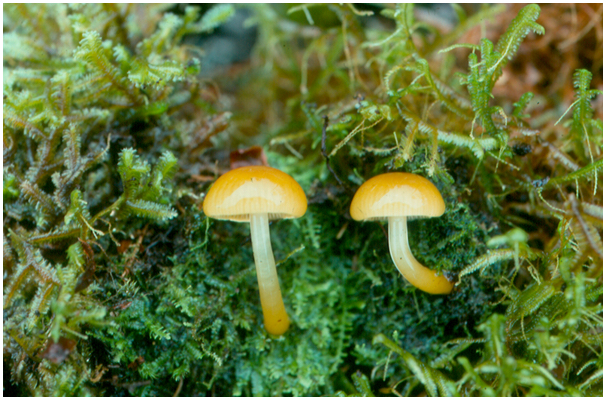
Hygrocybe pakelo is a native Hawaiian species, that only grows in native wet-montane forests. The species name ‘pakelo’ refers to the Hawaiian word that means “to slip out of the hand like a slippery fish”. This is indeed a very slippery mushroom, with yellow-golden cap and stem. It is known from only two islands of the Hawaiian archipelago. Native forests are under various threats, development and road construction (especially on Hawai’i), invasion of non-native plants and other organisms, and the spread of Rapid ʻŌhiʻa Death (Ceratocystis fimbriata), which kills Metrosideros polymorpha the most widespread and dominant native tree of Hawaii. A reduction in population size of more than 30% is projected within the span of 3 generations (30 years) for this species, due to the spread of the introduced pathogen that kills the overstory tree, M. polymorpha, which results in a decline in habitat quality. The species is likely to have a very small Extent of Occurrence and Area of Occupancy, and so Hygrocybe pakelo is listed as Endangered under criteria B1ab(ii,iii,iv,v)+2ab(ii,iii,iv,v).Taxonomic notes
This species potentially belongs in the genus Gliophorus because of the glutinous cap and stem.Geographic range
This species is endemic to Hawaii, U.S.A. Reported from three sites on Hawai’i (two less than 1 km apart), and one from Moloka’i.Population and Trends
The population is fragmented and consists of small subpopulations on different islands; at present it is known from three sites on Hawai’i, and one on Moloka’i. The habitat where they occur is fragmented as well, due to volcanic activities and the lava streams that surround the tree islands (kipukas) where the species occurs. Only four subpopulations are known, despite long-term surveys for this conspicuous fungus.
Population Trend: Decreasing