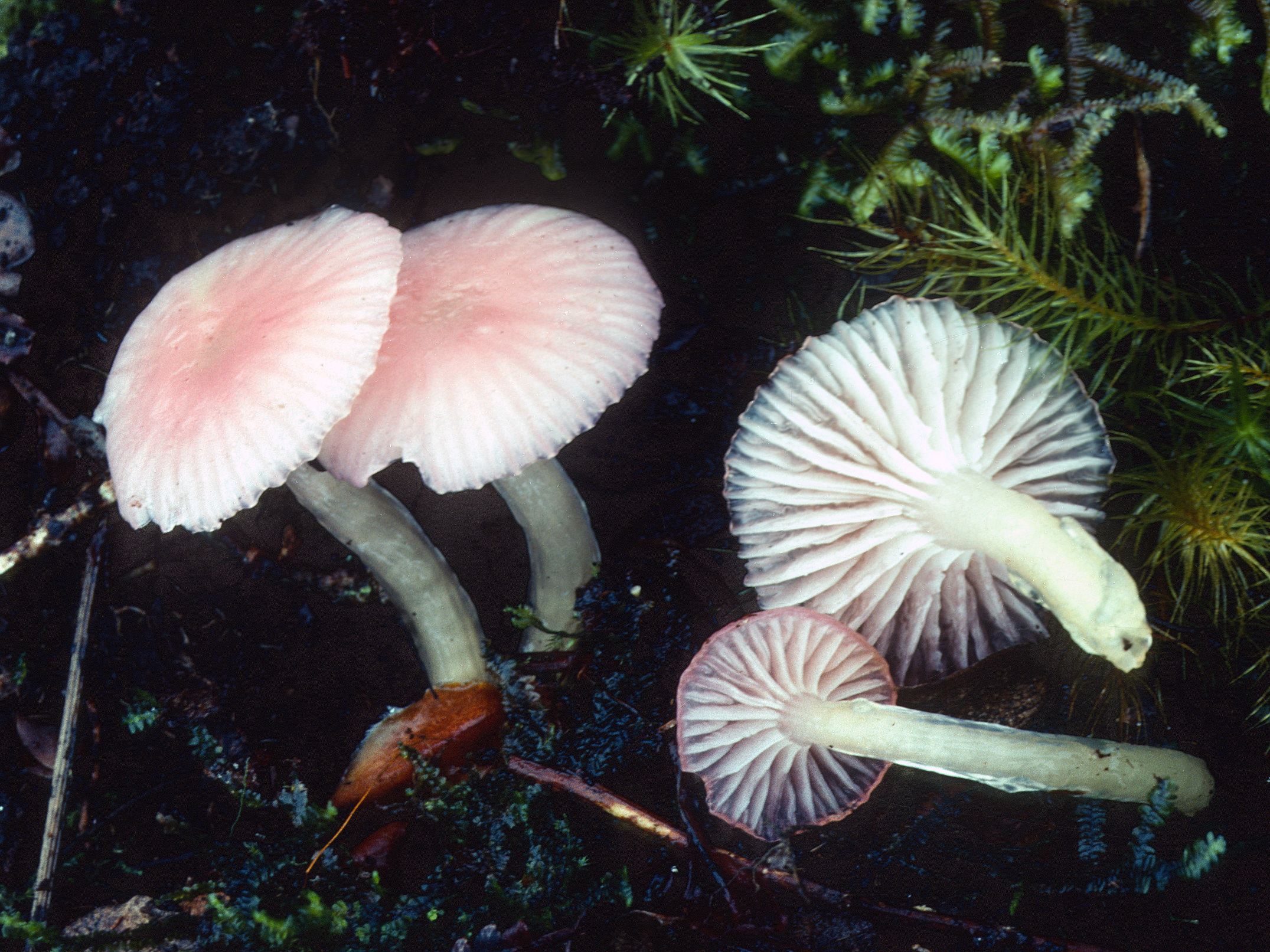
- Proposed
- Under Assessment
- Preliminary Assessed
- Assessed
- ENPublished
Hygrocybe noelokelani Desjardin & Hemmes
Search for another species...
- Scientific name
- Hygrocybe noelokelani
- Author
- Desjardin & Hemmes
- Common names
- IUCN Specialist Group
 Mushroom, Bracket and Puffball
- Kingdom
- Fungi
- Phylum
- Basidiomycota
- Class
- Agaricomycetes
- Order
- Agaricales
- Family
- Hygrophoraceae
- Assessment status
- Published
- Assessment date
- 2016-04-27
- IUCN Red List Category
- EN
- IUCN Red List Criteria
- C1
- Assessors
- Else Vellinga (UC Berkeley Herbarium, Berkeley, California, USA)
- Reviewers
- Anders Dahlberg (Swedish Species Information Centre, Uppsala / IUCN SSC Cup-fungus, Truffle and Ally Specialist Group)
Assessment Notes
The content on this page is fetched from The IUCN Red List of Threatened Species: https://www.iucnredlist.org/species/95384502/95385479
Justification
Hygrocybe noelokelani is native to Hawaii where it was found in three locations on the Big Island, and one on Kauai. It is restricted to Wet Montane Forests which are dominated by Metrosideros polymorpha (ʻŌhiʻa). This tree is under immediate threat by Rapid ʻŌhiʻa Death, a fast spreading disease caused by Ceratocystis fimbriata, so far restricted to the Big Island of Hawaii. Wet Montane Forest habitat is projected to decline at least 20% in the next 20 years, based on the spreading of the Ceratocystis wilt of M. polymorpha, the dominant tree in the habitat. A second threat is the widening of the Saddle Road on the Big Island; this project will destroy several of the kipukas (tree islands amid solidified lava streams) where Hygrocybe noelokelani was found.Therefore Hygrocybe noelokelani is classified as EN (Endangered) under criterion C1. The total number of mature individuals is estimated not to exceed 2,500.
Taxonomic notes
Hygrocybe noelokelani has fruitbodies that are covered in slime, and have a pink cap, a white stem and white gills. It differs from closely related species known to occur in New Zealand in the pink colours of the pileus (Dennis and Hemmes 1997). The name ‘noelokelani’ means ‘the pink rose in the mist or rain forest’.This species probably belongs in the genus Gliophorus, but there are no molecular data to support that, and a formal transfer to that genus has not been made.
Geographic range
Hygrocybe noelokelani is endemic to Hawaii (US) and from two islands of the Hawaiian archipelago, Big Island and Kauai.Population and Trends
Hygrocybe noelokelani is very rare, only known from a couple of sites on two small islands in Hawaii in threatened habitats (due to tree death and human activities). It has been looked for on the other islands by experienced mycologists who described the species but there are no records from them. It is conspicuous enough and easy to identify as well to be found and identified by amateurs as testified by an award winning essay by a 15-year old person (American Museum of Natural History 2002).
Population Trend: Decreasing