- Proposed
- Under Assessment
- Preliminary Assessed
- Assessed
- VUPublished
Lepiota brunneolilacea Bon & Boiffard
- Scientific name
- Lepiota brunneolilacea
- Author
- Bon & Boiffard
- Common names
 Star Dapperling
 Zandparasolzwam
 Sand-Schirmling
- IUCN Specialist Group
 Mushroom, Bracket and Puffball
- Kingdom
- Fungi
- Phylum
- Basidiomycota
- Class
- Agaricomycetes
- Order
- Agaricales
- Family
- Agaricaceae
- Assessment status
- Published
- Assessment date
- 2019-03-29
- IUCN Red List Category
- VU
- IUCN Red List Criteria
- D1
- Assessors
- Claudia Perini; Armin Mešić; Eef Arnolds (Foundation Paddestoelen Werkgroep Drenthe, The Netherlands)
- Reviewers
- Martyn Ainsworth (Royal Botanic Gardens, Kew, UK; IUCN SSC Mushroom, Bracket and Puffball Specialist Group)
Assessment Notes
Justification
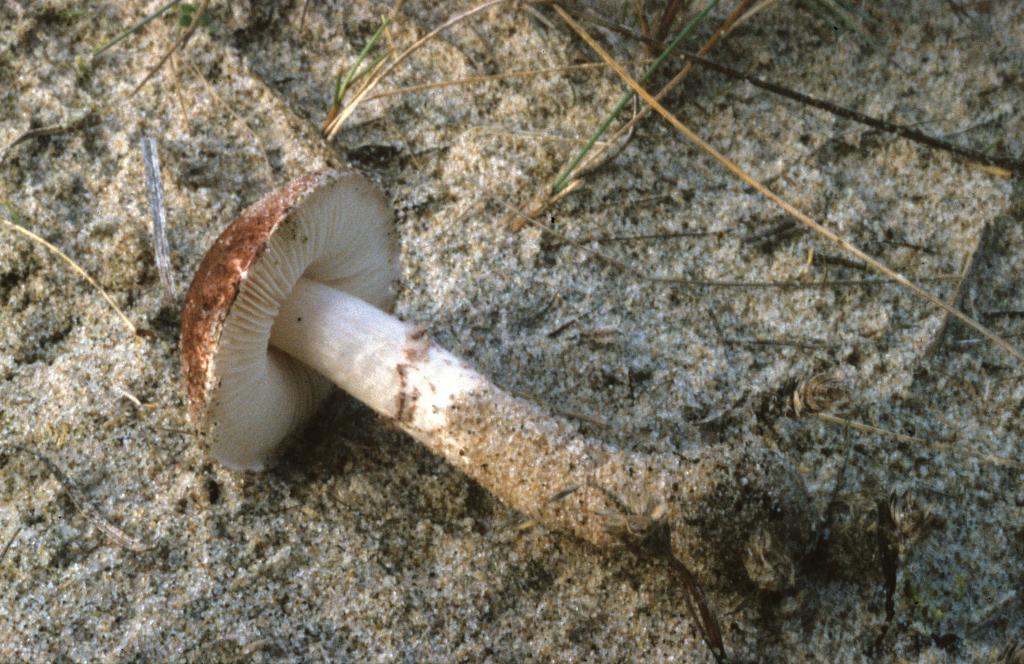
Lepiota brunneolilacea is a fairly large Lepiota species with a minutely scaly, vinaceous brown to lilac brown pileus of 30-75 mm and a sturdy stipe (20-80 x 8-15 mm) with a floccose annulus. It is one of the very few Lepiota species growing in dunes near the sea-coast, the stipe base often deeply buried in sand. The species has a restricted range along the coasts of western and southern Europe. The sites are potentially threatened by recreational development, artificial fixation of dune sand and, in the longer term, rising of the sea level, however the rate of any population decline is difficult to quantify. Its global population is estimated as under 1000 mature individuals. It is therefore assessed as VU D1.Geographic range
This species is found in south and west Europe, and north Africa: the coasts of Mediterranean Sea, North Sea and Baltic Sea. There is a record from Slovenia but this appears to be from a different habitat to other records and therefore needs confirmation. The records from Morocco also require confirmation.Population and Trends
Lepiota brunneolilacea is only known from a few localities within its limited distribution area, e.g. in the British Isles only from Jersey and Kent (Legon and Henrici 2006), in the Netherlands from two localities (Noordeloos et al. 2015), in Germany from one locality, in Italy from less than 10 localities (Onofri 2006). The number of localities, including possible undiscovered localities, is estimated as up to 200. Populations are small, usually consisting of 1-2 (max. 5) mycelia, so probably the world population is less than 1000 individuals. The occurrence in its sites is irregular. Figures on trends of this species are unknown, but there is a continuous loss of habitat and decrease of habitat quality, so we assume a decrease of the species.
Population Trend: Decreasing
Habitat and Ecology
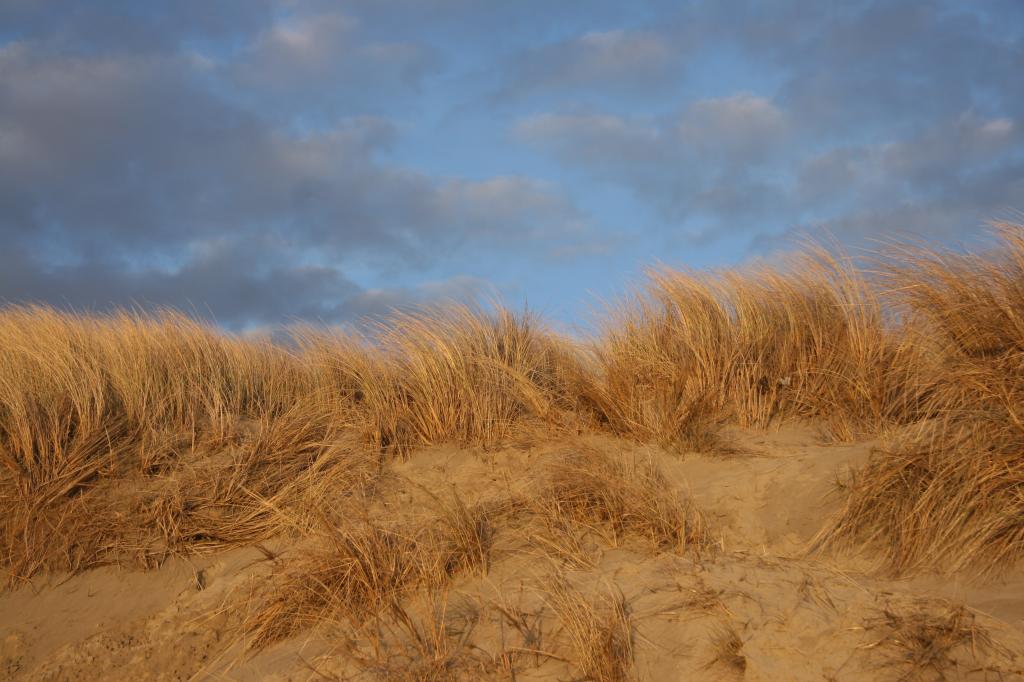
Lepiota brunneolilacea grows in dynamic, young coastal dunes, often near Ammophila arenaria, occasionally also near scrub of Hippophae rhamnoides and near Quercus ilex. There is also a small number of records from different inland habitats which need to be confirmed. It is apparently saprotrophic on buried organic matter.Although the species does not occur in very dry, highly dynamic dunes without vegetation, it is dependent on shifting sand generated in such habitats and it is therefore probably dependent on landscapes with shifting habitat mosaics. Landscapes with such dynamic habitat mosaics have become relatively rare (e.g. Janssen et al. 2016).
Among the Natura 2000 habitat types (as used in EU’s Habitat Directive) it occurs mainly in the habitat types 2020 ‘Shifting dunes along the shoreline with Ammophila arenaria (white dunes)’ and other dune types, all of which have an EU conservation status of Unfavourable-Inadequate or Unfavourable-Bad (EEA 2019).