- Proposed
- 2Under Assessment
- 3Preliminary Assessed
- 4Assessed
- 5Published
Gyrothrix verticiclada (Goid.) S. Hughes & Piroz.
- Scientific name
- Gyrothrix verticiclada
- Author
- (Goid.) S. Hughes & Piroz.
- Common names
- IUCN Specialist Group
 Cup-fungi, Truffles and Allies
- Kingdom
- Fungi
- Phylum
- Ascomycota
- Class
- Incertae sedis
- Order
- Incertae sedis
- Family
- Incertae sedis
- Assessment status
- Proposed
- Proposed by
- Marcela Barbosa
- Comments etc.
- Marcela Barbosa, Elaine Malosso, David Minter
Assessment Notes
Taxonomic notes
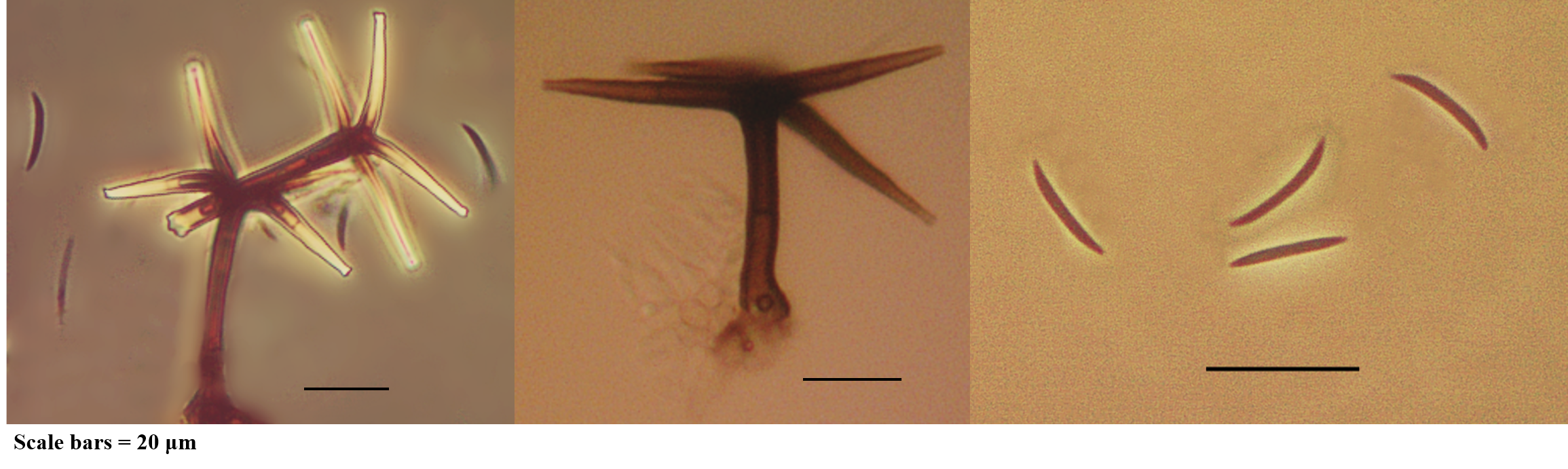
The genus Gyrothrix Corda (Corda) is characterized by the production of long setae (simple or ramified). The species Gyrothrix verticiclada (Goid.) S. Hughes and Piroz. the setae are dichotomic or verticillate, septate, intense dark brown, the conidiogenous cells are ampulliform to lageniform, percurrent, intense clear brown and the conidias are falcate, with pointed apices, hyaline (Hughes; Pirozinski, 1971). The morphological characters of Gyrothrix specimens are very to Circinotrichum, which differs by the presence of branched setae. These, in Gyrothrix, are to fundamental importance for the identification of species (Pirozinski, 1962).
Why suggested for a Global Red List Assessment?
The study of fungi in various environments can help to expand knowledge of the diversity of these fungi, as well as find conservation measures for these microorganisms.
Geographic range
In climate tropical, subtropical, temperate
Population and Trends
It has been records of this species in almost all continents, except Antartida and in desert regions. This is species was found on dead leaves of Gyranthera caribensis in Venezuela (Castañeda-Ruiz et al., 2003), Knightia excelsa in New Zealand (Hughes; Pirozinsky, 1971), Laurus nobilis in England (Kirk, 1992), Smilax aspera in Italy (Rambelli et al., 2008 and in unknown leaf litter as in Mexico and Cuba (Heredia-Abarca et al., 1997; Delgado-Rodríguez et al., 2002).
Population Trend: Uncertain
Habitat and Ecology
Saprobic on leaves and leaf litter
Threats
Conservation Actions
None
Research needed
Pleoanamorphy with two types of conidia is related for Gyrothrix verticiclada. The first conidial type has the normal morphology already known for G. verticiclada, but the second conidial type is identified was an Idriella-like synanamorph. Were realized a phylogenetic analysis of DNA sequences from three gene regions (ITS, LSU and tef1a) and morphological data. Phylogenetic analyses were performed with maximum parsimony. The teleomorphic connection suggests a correspondence with named genera belonging to the order Xylariales (Becerra-Hernández et al., 2016).
Use and Trade
None