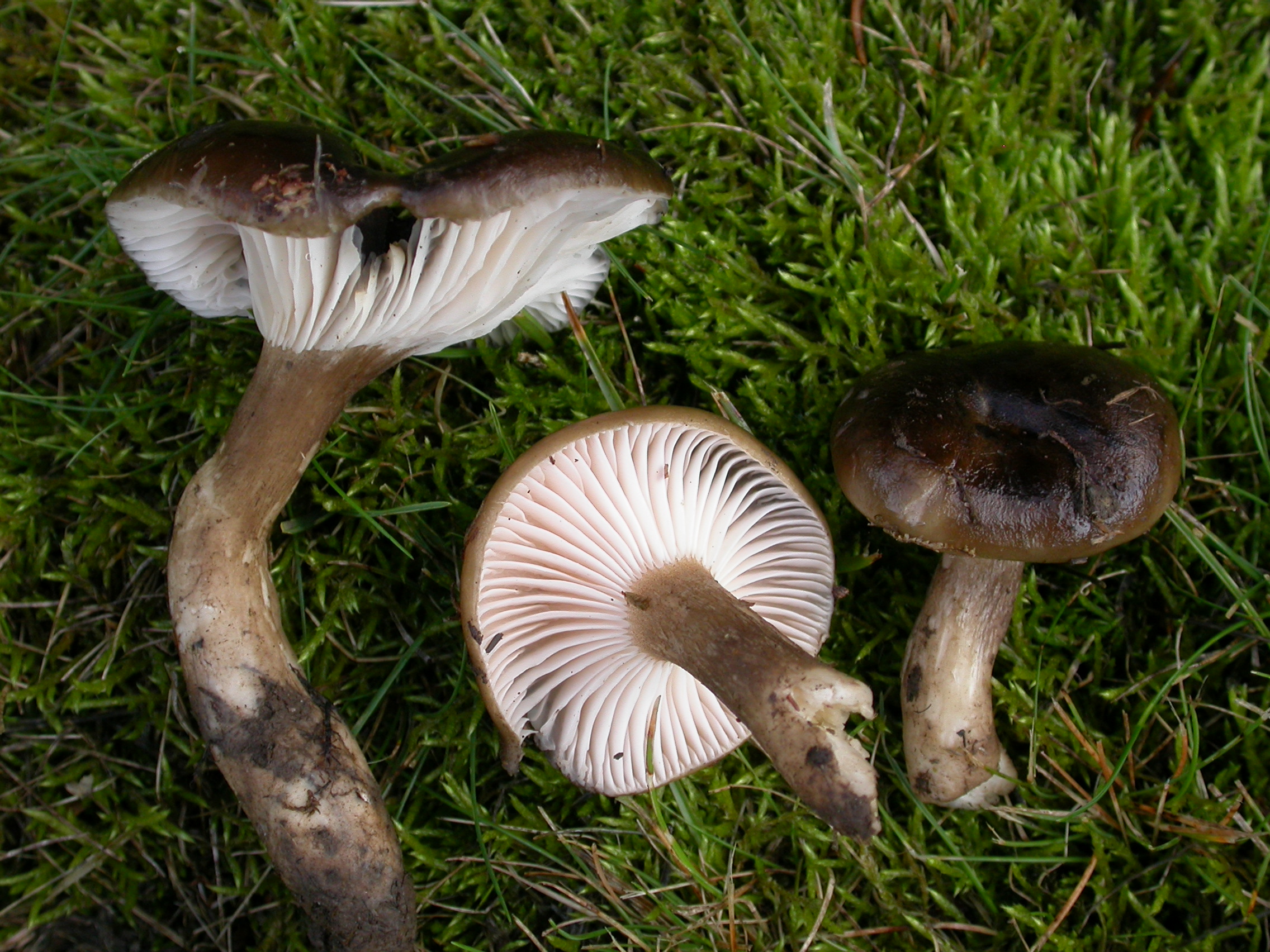
- Proposed
- Under Assessment
- Preliminary Assessed
- Assessed
- ENPublished
Hygrophorus calophyllus P. Karst.
- Scientific name
- Hygrophorus calophyllus
- Author
- P. Karst.
- Common names
 Rusohelttavahakas
 Rosaskivig vaxskivling
 fagervokssopp
 Schönblättriger Schneckling, Rosablättriger Schneckling
- IUCN Specialist Group
 Mushroom, Bracket and Puffball
- Kingdom
- Fungi
- Phylum
- Basidiomycota
- Class
- Agaricomycetes
- Order
- Agaricales
- Family
- Hygrophoraceae
- Assessment status
- Published
- Assessment date
- 2019-03-26
- IUCN Red List Category
- EN
- IUCN Red List Criteria
- A2c+3c+4c
- Assessors
- Tea von Bonsdorff (Finnish Museum of Natural History)
- Reviewers
- Anders Dahlberg (Swedish Species Information Centre, Uppsala / IUCN SSC Cup-fungus, Truffle and Ally Specialist Group)
Assessment Notes
Justification
Hygrophorus calophyllus is an easily recognizable, robust fungus with salmon-red coloured gills. In Europe, the species is a indicator species of old, calcareous conifer forests which have high conservation values and a rich fungal biodiversity. It has a sparse circumboreal distribution with less than 100 known localities. The total population size is estimated not to exceed 2,500 mature individuals. Due to forestry, the number of localities is suspected to have declined with more than 50% and continue to decline. Hence, H. calophyllus is assessed as Endangered (EN) under criterion A2c+3c+4c, due to population reduction of more 50% in 50 years (three generations), and under C1 (small population size and suspected continuing decline with under 2,500 mature individuals).Geographic range
Hygrophorus calophyllus has a circumboreal distribution. It is very rare and has a fragmented occupancy. The core population in Europe is located in Sweden and Norway. It has a few records from central Europa and North America. Reported occurrences in Italy and Japan have not been confirmed.Population and Trends
Hygrophorus calophyllus is currently known from about 85 localities of which 50 are located Europe (predominantely in), and 35 localities in North America.
The total number of localities, including yet unrecorded sites, is suspected not to exceed 200, due requirement of particular habitat type. The total population size is estimated not to exceed 2,500 mature individuals. The species is very rare in throughout the boreal and only have a few records in the temperate zone. This species is suspected to have declined during the last 50 years in Europe, due to loss of habitat area and reduced habitat quality caused by forestry (logging) (cf. Kotiaho 2017, Svensson et al. 2019). Similar habitat decrease has taken place and is going on in North America.
The habitats of H. calophyllus are small in area and those are threatened in many countries in Northern Europe (e.g. Brandrud and Bendiksen 2018). The same trend has been reported from North America with similar population/habitat decline and is due e.g. continued loss of habitat, decline in old growth forest areas, and replacing fires are likely detrimental to this species (Siegel 2017).
The species is estimated to have decreased by more than 50% in three generations and the decline (50 years, Dahlberg and Mueller 2011) based on habitat-loss of old-growth forests on calcareous soils and continuing decline, but the number of localities is very low with ca 50 known localities in Europe (eg. Sweden 10-20; Norway 15-20; Russia 5, Croatia 1). USA with 35 (Siegel 2019). The species has been evaluated as threatened in Norway (EN), Sweden (EN) and Croatia (CR). It is reported as regionally extinct (RE) from Finland (von Bonsdorff et al. 2019) as last collected in 1889.
Population Trend: Decreasing