- Proposed
- Under Assessment
- 3Preliminary Assessed
- 4Assessed
- 5Published
Naiadolina flavomerulina (Redhead) Redhead, H. Labbé & Ginns
- Scientific name
- Naiadolina flavomerulina
- Author
- (Redhead) Redhead, H. Labbé & Ginns
- Common names
- IUCN Specialist Group
 Mushroom, Bracket and Puffball
- Kingdom
- Fungi
- Phylum
- Basidiomycota
- Class
- Agaricomycetes
- Order
- Agaricales
- Family
- Physalacriaceae
- Assessment status
- Under Assessment
- Proposed by
- Jean Berube
- Assessors
- Jean Berube
- Comments etc.
- Patrick Leacock, Anders Dahlberg
Assessment Notes
DD
Taxonomic notes
Why suggested for a Global Red List Assessment?
EXPLAIN MORE CLEARLY THE LARGE PICTURE HERE
Small but easy to identify species in a very restricted habitat and a host under heavy grazing pressure by overpopulated migrating wild geese.
Geographic range
-four records in Mycoportal: all from one station Ginn’s farm in Québec, Canada.
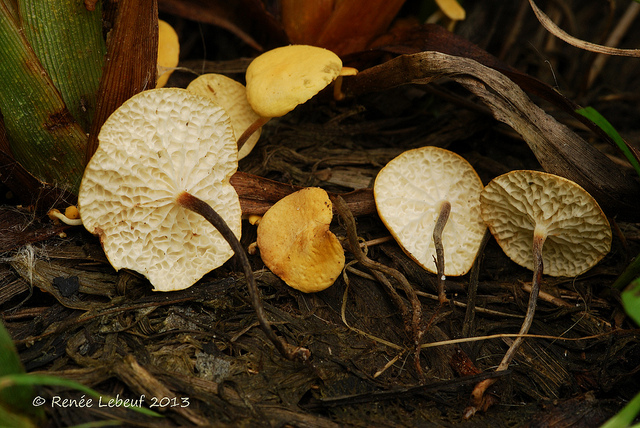
-found by Renée Lebeuf in Montreal (Morgan Arboretum) Québec ,Canada
-mentioned in Nova-Scotia Canada, but specimen is not curated
Population and Trends
-described in 1979, recently changed into a new genera
-very distinctive species, easy to recognize but not well knownWith 4 records all in Eastern Canada, very distinctive species, easy to recognize but not well known by mycologists.
Found in only 2 localities worldwide, but the number of localities may be up to 100 times higher since it is rather unpublicised as an existing species and its habitat being muddy wetlands which are not readily explored for fungi, so we estimate is is to be found in 200 localities. This estimate corresponds to 400 genetically unique mycelia. The number of ramets are expected to be 10 times higher, so total number of individual worldwide is estimated to be 4000. We propose the status DD as its wetland habitat has been reduced greatly in the last 50 years, and its host is under heavy grazing my migrating geese.
Better estimation of number localities by surveys should give us better estimates of unknown localities.
Population Trend: Decreasing
Habitat and Ecology
It is a saprotroph species living on dead tissues of Scirpus rubrotinctus, a very common plants in wetlands. It may also on Carex sp. Wetlands where Scirpus occur are common but they are found in a restricted band along rivers. Wetlands are in decline in eastern Canada. There is tremendous pressure particularly on Scirpus because of overgrazing by overpopulated migrating geese.
This species has a rather restricted habitat and limited number of hosts, greatly limiting its area of occupancy.
Threats
Wetlands have greatly diminished in the last 50 years in eastern Canada and there is tremendous pressure particularly on it host Scirpus because of overgrazing by overpopulated migrating geese. Geese are grazing both in spring and fall on Scirpus.
Conservation Actions
Protection of Scirpus is already in effect by allowing spring and fall hunting of overpopulated migrating geese. Known wetland site where N. flavomerulina is reported could be prioritized for extra protection .
The existence of this species is an extra incentive for protection of wetlands.
Research needed
In northeastern North America, where this species is found, there are numerous groups of amateur mycologists. Members of these groups can be recruited and instructed where to find and how to identify this species so they can target this species during forays. Data from amateur mycologists can be critical to define its population size, distribution and trends.
Surveys of Scirpus sp. sites by local amateur mycologists will be help to document and estimate the number of unknown sites and the area of occupancy to diminish the uncertainty factor used to estimate populations.